Table of Contents
- Step 1: Decide Whether Your Furniture Is Donation-Ready
- Step 2: Find Furniture Donation Pickup Near Me: Matching Items to the Right Organization
- Step 3: Schedule Your Furniture Donation Pickup
- Step 4: Prepare Furniture for Donation (Cleaning and Access)
- Step 5: Claim Your Tax Deduction for Furniture Donation
- How to Dispose of Old Mattress: Donation, Recycling, or Hauling
- When Donation Isn’t Possible: Alternatives and Eco-Friendly Disposal
- Frequently Asked Questions
Last Updated: October 4, 2026
Step 1: Decide Whether Your Furniture Is Donation-Ready
The best way to donate old furniture starts with one honest question: would you give this piece to a friend?
This guide from Hoosier Junk Daddy walks you through the full process, from sorting your items to claiming your tax deduction.
Here’s the good news: most gently used furniture finds a second home quickly. The trick is knowing what passes inspection and what doesn’t.
Condition Checklist: What Charities Actually Accept
Most charities accept furniture that is clean, structurally sound, and free of stains, tears, or odors. Anything you’d comfortably sell at a garage sale usually qualifies.
Run through this list before you schedule anything:
- No broken frames, legs, or joints
- Drawers open, close, and stay on track
- Upholstery is stain-free with no rips or pet damage
Items from smoke-free, pet-free homes move fastest. A quick wipe-down with a damp cloth can turn a “maybe” into a “yes.”
Items That Get Rejected (and What to Do Instead)
Charities turn away items they can’t resell or that pose a safety risk. Knowing the reject list saves you a wasted pickup appointment.
Common rejections include:
- Mattresses with stains, tears, or sagging
- Cribs and car seats that don’t meet current safety standards
- Recalled furniture of any kind
For these items, recycling or professional hauling is usually the better path. We’ll cover those options below.
Step 2: Find Furniture Donation Pickup Near Me: Matching Items to the Right Organization
Searching for furniture donation pickup near me works best when you match the item to the right organization first.
National groups like The Salvation Army run dedicated truck fleets and let you schedule a home pickup online. Goodwill has drop-off locations nearly everywhere but offers pickup at only some stores.
| Organization | Best For | Pickup Service | Notes |
|---|---|---|---|
| The Salvation Army | Large furniture, national coverage | Yes, online scheduling | Longer waits during peak season |
| Habitat for Humanity ReStore | Quality furniture and building materials | Varies by location | Proceeds fund local homebuilding |
| Goodwill | Smaller items, quick drop-off | Limited locations | No appointment needed to drop off |
| Furniture Bank Network | Direct family impact | Through regional affiliates | Only in certain regions |
| AMVETS | Veteran programs | Select regions | Not available everywhere |
| The Arc | Disability services | Many communities | Guidelines vary by chapter |
Call ahead before you load anything. A two-minute phone call beats a wasted afternoon.
National Charities vs. Local Furniture Banks
National charities offer convenience and wide coverage.
The trade-off is reach. Furniture banks only exist in certain regions, so availability depends on where you live. National groups almost always have a location nearby.
If direct community impact matters to you, search for a local furniture bank first. If speed and reliability matter more, a national charity is the safer bet.
Step 3: Schedule Your Furniture Donation Pickup
Scheduling a pickup takes about five minutes online with most national charities. You pick a date window, list your items, and leave them accessible on pickup day.
Here’s what to expect:
- Book online or by phone at least one to two weeks ahead.
- Confirm which items the driver will take.
- Get a confirmation window, usually a half-day block.
- Move items to a garage, porch, or curbside spot.
- Ask for a donation receipt at pickup.
Wait times stretch during spring cleaning season and around the holidays. If your timeline is tight, book early or consider a same-day hauling service.
Step 4: Prepare Furniture for Donation (Cleaning and Access)
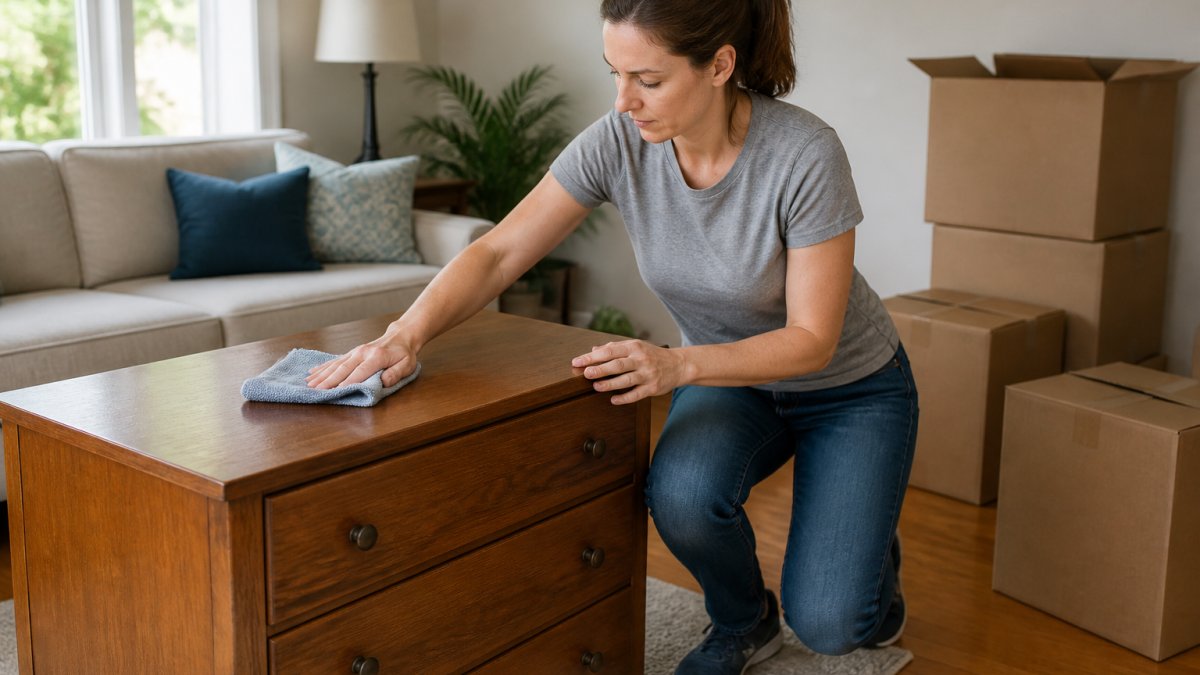
Preparation is where most donors lose their pickup slot. Drivers work tight routes, and they’ll skip items that aren’t ready.
Do these five things the night before:
- Clean it. Wipe surfaces, vacuum upholstery, and remove crumbs from drawers.
- Empty it. Clear every drawer, shelf, and compartment.
- Tape it. Secure doors and drawers with painter’s tape so nothing swings open.
Tape a note with your confirmation number to the largest item. Drivers on tight routes move fast, and a visible note prevents mix-ups with neighbors’ donations.
Step 5: Claim Your Tax Deduction for Furniture Donation
A tax deduction for furniture donation only reduces your bill if you itemize on your federal return using Schedule A.
Assuming you itemize, the deduction equals the item’s fair market value (FMV), what a willing buyer would pay for that piece, in its current condition, at a thrift store or in a resale listing. Not what you paid. Not what a new one costs.
How to Estimate Fair Market Value Without Guessing
There’s no official IRS price list for a used dresser, so you build your own evidence trail. A defensible method most tax preparers accept:
- Find three comparable sold prices. Search resale listings and thrift-store pricing for the same item type, brand, and condition. Record what comparable pieces actually sell for, not asking prices.
- Apply a condition discount. A common pattern is to value “good, gently used” furniture at roughly 20-30% of its original retail price, and “fair” condition lower still. Use this as a sanity check, not a rule.
- Round down, not up. When two values are plausible, claim the lower one. Overstatement is the audit risk, not understatement.
- Document each item separately. A line-item list (item, condition, estimated FMV, source) is far stronger than one lump total.
The IRS Paperwork Thresholds You Need to Know
The documentation requirement scales with the size of your deduction:
- Under $250 (per item or per trip): A receipt from the charity is enough. If a receipt isn’t practical, keep your own written record of what you gave and when.
- $250 or more (single donation): You must obtain a written acknowledgment from the charity before you file. It has to state whether you received any goods or services in return. A bank record or a verbal confirmation does not satisfy this.
- More than $500 (total noncash gifts for the year): You generally must file Form 8283, Section A, with your return.
A pickup receipt that only says “miscellaneous household items” is weak documentation. Ask the driver to itemize, or attach your own itemized list to the receipt and keep both. Never claim full retail price for used furniture, FMV is the standard, and inflated values are a common audit trigger for donated goods.
Build a Donation File Before the Truck Arrives
Five minutes of prep protects the whole deduction:
- Photograph each item in place, ideally with a date stamp.
- Note the condition in writing (“good, gently used, minor scuff on left leg”).
- Save your comparable-price research (screenshots or notes).
For the authoritative rules, see the IRS guide to charitable contributions and IRS Publication 561 on determining value. When in doubt about a high-value piece, ask a tax professional before you file, the cost of a question is far lower than the cost of a disallowed deduction.
How to Dispose of Old Mattress: Donation, Recycling, or Hauling
Learning how to dispose of old mattress comes down to condition. A clean, stain-free mattress in good shape can sometimes be donated. Most mattresses, though, get rejected because of stains, sagging, or wear.
Your realistic options:
- Donate it. Only if it’s spotless and most charities in your area accept mattresses.
- Recycle it. Many states run mattress recycling programs that break down steel, foam, and fabric. Check your state environmental agency for local options.
- Haul it. A junk removal service takes it off your hands and routes it to the right facility.
Mattresses are bulky and hard to move alone. If donation isn’t an option, professional hauling is usually the fastest path.
When Donation Isn’t Possible: Alternatives and Eco-Friendly Disposal
Not every item deserves a second life, but “donation failed” doesn’t mean “landfill.” Work down this hierarchy and stop at the first option that fits the item’s condition.
The Disposal Decision Tree
Ask these questions in order:
- Is it clean, structurally sound, and safe? → Donate it. This is the highest-value outcome.
- Is it broken but repairable, or does it have good bones? → Repair it, or repurpose it (a dresser becomes garage storage; a tabletop becomes a workbench).
- Is it beyond repair but made of recoverable material? → Recycle it. Metal frames, wood, and textiles all have recycling pathways.
- Is it contaminated, recalled, or a safety hazard? → Landfill, as a last resort.
The goal is simple: keep the most material in play and send the least to the landfill.
What Actually Gets Recycled
- Metal furniture (frames, legs, filing cabinets) is the easiest win, scrap metal has real resale value and most communities accept it.
- Wood furniture can sometimes be broken down at a transfer station or accepted by a wood-recycling operation; check your local solid-waste authority.
- Mattresses are the hardest common item. Many states and municipalities run dedicated mattress-recycling programs that separate steel, foam, and fabric. Check your state environmental agency for local options.
Moving Large Furniture Without a Truck
This is where most urban donors get stuck. A sofa won’t fit in a sedan, and rental trucks require a driver and a parking plan. Here are the realistic options, roughly in order of cost:
- Charity pickup. If the item qualifies, this is the cheapest path, the charity brings the truck. Book one to two weeks ahead.
- Friends, a hand truck, and a dolly. For a single dresser or small sofa within a few blocks, a furniture dolly and two people can do it. Measure every doorway and elevator first.
- Professional junk removal or hauling. The most expensive option, but it handles the lifting, the stairs, and the disposal routing. Best reserved for items no charity will take.
Before you move anything, measure the item and the narrowest point on the path, the front door, the stairwell turn, the elevator opening. A piece that fit on the way in doesn’t always fit on the way out once it’s assembled.
Where a Full-Service Hauler Fits
When an item is too damaged to donate and too bulky to move yourself, a hauler earns its keep by handling the heavy lifting, the sorting, and the routing to the right facility. Hoosier Junk Daddy diverts up to 60% of hauled items from landfills through recycling and donation, so your old furniture still has the best shot at a second life even when it leaves your home on a truck.
The best way to donate old furniture is to sort first, schedule early, and keep a receipt. For anything a charity won’t take, work down the hierarchy, repair, repurpose, recycle, and treat the landfill as the last stop, not the default.
Frequently Asked Questions
What is the best charity to donate furniture to?
The best charity depends on your priorities. Habitat for Humanity ReStore supports affordable housing and accepts building materials and furniture. The Salvation Army offers nationwide pickup scheduling. Local furniture banks distribute items directly to families in need. For high-end pieces, Housing Works runs professional pickup in some cities. Check each organization’s donation guidelines and pickup availability in your area before scheduling.
Are there tax benefits for donating used furniture?
Yes, if you itemize deductions on your federal return and donate to a qualified 501(c)(3) organization. You can deduct the fair market value of furniture in good used condition. The IRS requires a written receipt for donations over $250, and Form 8283 for noncash contributions over $500. Keep photos and a detailed list of items donated to support your valuation.
How do I schedule a furniture donation pickup?
Most national charities let you schedule online or by phone. The Salvation Army uses satruck.org, and Habitat ReStore has a locator tool. You’ll provide your address, a description of items, and choose a pickup window. Local furniture banks may have different processes. Confirm what items are accepted, whether stairs or elevators affect pickup, and if there are any fees before the truck arrives.
How do I dispose of an old mattress if it can’t be donated?
Many charities reject mattresses due to hygiene concerns. Check with local recycling centers that accept mattress components, or ask your waste management provider about bulk pickup. Some retailers offer haul-away when you buy a new mattress. If none of those work, a junk removal service can transport it responsibly, often diverting materials from the landfill through recycling partners.
Old furniture piles up fast, and figuring out what to donate, recycle, or haul takes time you may not have. Hoosier Junk Daddy makes it simple with free on-site estimates, same-day service when possible, and eco-friendly disposal that keeps usable items out of the landfill. We handle the lifting, loading, and cleanup so you don’t have to. Get started with Hoosier Junk Daddy and reclaim your space today.