Last Updated: October 22, 2026
Quick Summary
The best vertical storage solutions for garages are wall rails, steel shelving, overhead ceiling racks, and vertical bike hooks or lifts. Open steel shelving offers the lowest cost per pound of capacity and is the right starting point for most garages. Add enclosed cabinets and overhead racks only after the basics are in place.
- Wall rail systems like Rubbermaid FastTrack cost $30-$80 for the rail plus $10-$40 per accessory.
- The HDX 5-Tier Steel Shelving Unit was named a budget pick at $109 from Home Depot.
- The Ulti Mate Garage Cabinet Kit earned a best overall nod with a listed price of $2,330 at Amazon.
- SafeRacks two-tier overhead units hold 300-600 lb total on most models.
- Measure ceiling height under the garage door track, since it is usually the lowest point.
Table of Contents
- Why Vertical Storage Beats Floor Storage in a Garage
- Quick Comparison: Cost, Capacity, and Best Use
- Garage Wall Storage Ideas That Clear the Floor
- Garage Shelving Ideas: Steel Racks and Cabinet Kits
- Overhead Garage Storage Racks: Using Ceiling Space
- Vertical Bike Storage and Awkward Seasonal Items
- Safety, Load Limits, and Installation Requirements
- Measuring Your Garage Before You Buy
- Frequently Asked Questions
Why Vertical Storage Beats Floor Storage in a Garage
A garage floor fills up one item at a time until the car no longer fits. That is the pattern we see on nearly every cleanout, and it almost always starts with the same mistake: treating the floor as the only place things can go.
Floor storage costs you square footage. Vertical storage costs you nothing but a few hours with a drill.
The Four Types of Vertical Storage
Vertical storage is any system that stacks or hangs items along a wall, ceiling, or freestanding frame instead of spreading them across the floor. In practice, garages use four formats:
- Wall-mounted systems: rails, pegboards, and slatwalls that hang tools and ladders
- Freestanding shelving and cabinets: steel racks and enclosed units that stand on their own
- Overhead racks: platforms suspended from ceiling joists for bulky, light items
Each format solves a different problem. A pegboard will not hold a canoe, and an overhead rack is useless for screwdrivers.
Quick Comparison: Cost, Capacity, and Best Use
Product roundups tend to list systems one after another without letting you compare them on the dimensions that actually decide a purchase: footprint, capacity, installation difficulty, and typical cost.
| Storage type | Suitable items | Footprint | Typical capacity | Installation difficulty | Typical cost |
|---|---|---|---|---|---|
| Wall rail system (e.g., Rubbermaid FastTrack) | Tools, ladders, bikes, cords, brooms | 4-8 ft of wall, 3-6 in. deep | 50-100 lb per hook or bracket, depending on anchor | Moderate, must hit studs | $30-$80 for the rail; $10-$40 per accessory |
| Pegboard or slatwall | Small hand tools, cords, light parts | 2-4 ft of wall, 1/4-3/4 in. deep | 5-25 lb per hook; panel load limited by fasteners | Easy to moderate | $20-$60 per panel; hooks extra |
| Steel shelving unit (e.g., HDX 5-Tier) | Totes, coolers, paint, bulk supplies | 3-4 ft wide, 1.5-2 ft deep | 200-800 lb per shelf on most 5-tier steel units | Easy, assemble and anchor | $80-$150 |
| Enclosed cabinet kit (e.g., Ulti Mate) | Tools, chemicals, finished-garage storage | 6-12 ft of wall run, 1.5-2 ft deep | 100-300 lb per shelf, varies by cabinet | Moderate to high, leveling and anchoring | $1,500-$3,000+ per kit |
| Overhead ceiling rack (e.g., SafeRacks) | Holiday bins, screens, folding tables, empty coolers | 4×4 to 4×8 ft platform, hung 2-4 ft below ceiling | 300-600 lb total on most two-tier units | Moderate, joist check required | $150-$400 per unit |
| Vertical bike hook or lift | Bicycles, ladders, long-handled tools | 2-3 ft of wall or ceiling per bike | 50 lb (hook) to 100 lb (pulley lift) | Easy to moderate | $15-$60 per hook; $30-$100 per lift |
| Door-mounted organizer | Small tools, shoes, cleaning supplies | Door width, 3-6 in. deep | 20-50 lb total | Easy, no studs needed | $20-$60 |
Two patterns stand out when you line the formats up. First, cost per pound of capacity is lowest with open steel shelving, which is why it is the right starting point for most garages. Second, the systems that look cleanest, enclosed cabinets and overhead racks, carry the highest upfront cost and the most installation risk, so they belong after the basics are in place.
Prices for the HDX and Ulti Mate units come from Better Homes & Gardens’ garage storage roundup. Rail, overhead, and hook systems vary widely by kit size, so check current listings before you commit.
Buy one format at a time and live with it for a week before adding the next. Most garages end up with a wall rail plus one shelving unit, not a full cabinet run.
Garage Wall Storage Ideas That Clear the Floor
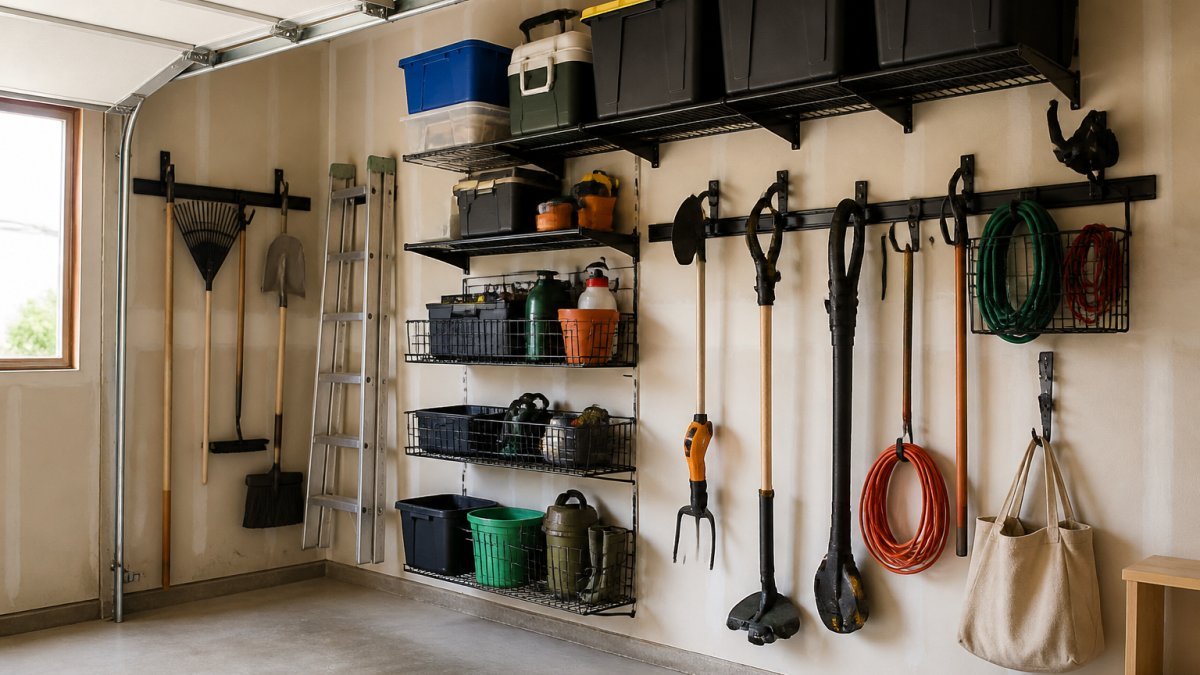
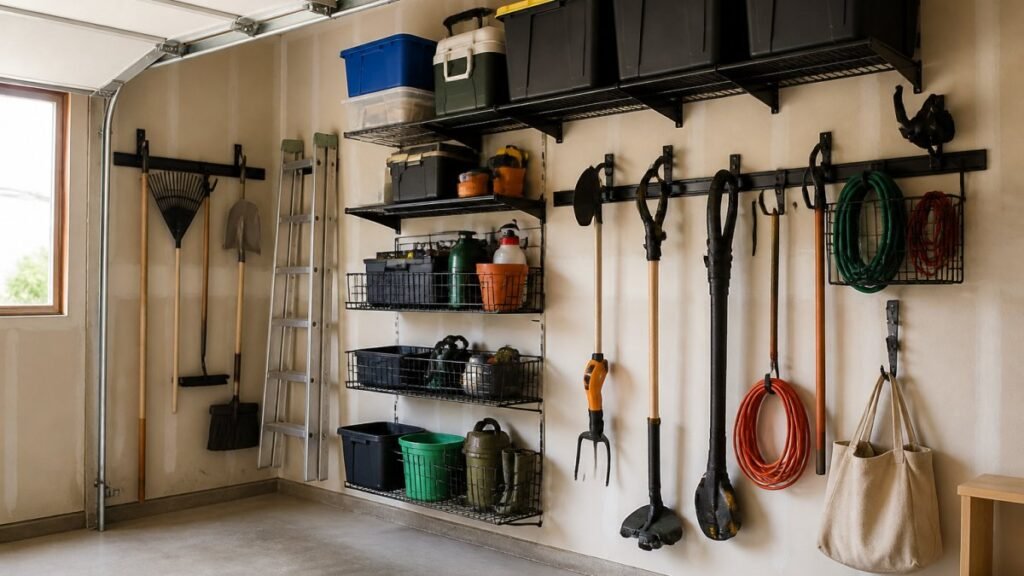
Wall storage is the fastest win in any garage. It takes gear that normally sits at ankle height and lifts it to eye level, which frees the floor for the car and the walkway.
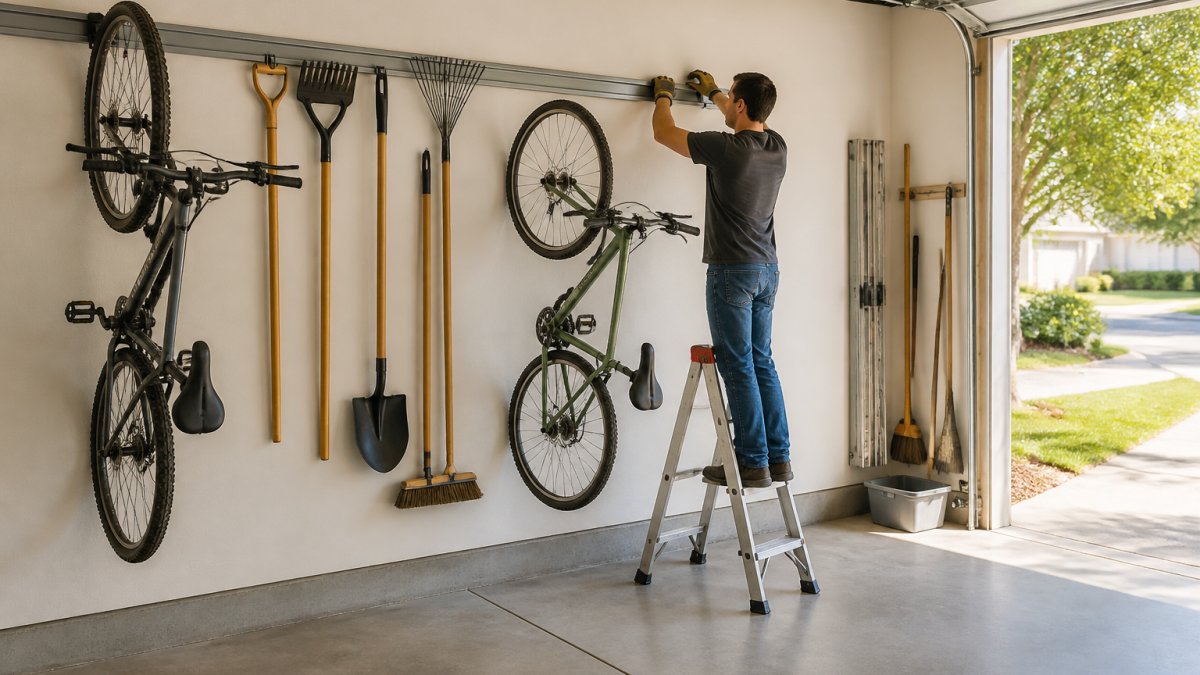
Rubbermaid FastTrack Rail System
The FastTrack rail is a horizontal bar bolted to wall studs, with hooks, baskets, and brackets that clip on and slide. The Spruce’s garage storage review highlights it as a strong option for using wall space. Our take: it is the best first purchase for most garages because you can start with one rail and add accessories as you go.
Pegboards and Slatwalls
Pegboards suit small hand tools, cords, and anything you want visible at a glance. Slatwalls carry more weight and look cleaner. Both fail the same way: people overload the top row and the panel pulls out of the wall. Anchor into studs or use proper toggle hardware rated for the load.
Hanging a rail or pegboard into drywall without studs is the most common installation mistake we see. The system holds for a few months, then drops a loaded shelf onto the car hood.
Garage Shelving Ideas: Steel Racks and Cabinet Kits
Shelving gives you the most storage per dollar, and it is where most garages should start. Steel units handle heavy totes and paint cans; cabinet kits hide the mess behind doors.
HDX 5-Tier Steel Shelving Unit
Better Homes & Gardens named this its budget pick at $109 from Home Depot. Five tiers of steel, assembled in under an hour, and it handles the bulky stuff: storage bins, coolers, cases of supplies. The honest limitation is that open shelving shows everything. If visible clutter bothers you, this is not your system.
Ulti Mate Garage Cabinet Kit
The Ulti Mate kit earned Better Homes & Gardens’ best overall nod with a listed price of $2,330 at Amazon. It delivers a coordinated, enclosed setup that looks built-in and keeps tools out of sight. That price is real money for a garage, and the supplied listings do not spell out every included cabinet, so confirm the kit contents before ordering.
Assemble steel shelving on the floor, then tip it upright against the wall and anchor the top to a stud. Units that are not anchored walk forward every time you pull a heavy tote.
Overhead Garage Storage Racks: Using Ceiling Space
Ceiling space is the most wasted real estate in a garage. Overhead racks suspend a platform from the joists and hold the items you need twice a year: holiday bins, camping gear, window screens, folding tables.
SafeRacks Two-Tier Overhead Unit
Bob Vila’s garage organizer review notes SafeRacks for its two-tier design, which doubles the platform height without eating more ceiling footprint. It is a smart pick for a two-car garage with tall ceilings and bulky seasonal items. The tradeoff is access: you need a sturdy ladder every time, so store only what you rarely touch up there.
Put heavy items low and light items high. Overhead racks are for pillows, bins, and empty coolers, never for engine blocks or paint.
Vertical Bike Storage and Awkward Seasonal Items
Bikes are the classic garage floor invader. A vertical bike hook or lift hangs the frame by its front wheel against the wall, reclaiming roughly the footprint of a small car.
Seasonal items need the same treatment. Window screens, storm windows, folding tables, and holiday decorations stack neatly on a wall rack or overhead platform. Label every bin on the visible side so you are not pulling down six boxes to find one.
Safety, Load Limits, and Installation Requirements
Every vertical system has a weight rating, and exceeding it is how garages get damaged. Check the manufacturer’s stated capacity for the whole unit and for each shelf, then stay under it.
Overhead racks need a joist check before anything else. Confirm the ceiling structure can carry the rack plus its contents, and keep the load balanced across the platform.
Measuring Your Garage Before You Buy
Most buying mistakes in a garage are measurement mistakes, not product mistakes.
**1.
**2.
3. Door clearance and swing. Measure the width and height of the vehicle opening and the arc of any personnel door.
**4.
5. Access paths. Trace the route from the garage door to the house door and to any frequently used items.
6. Load path. Note where the wall studs are (typically 16 in. on center) and where the ceiling joists run.
Once you have the numbers, sort your gear into three piles: keep, donate, and haul away. No storage system fixes too much stuff. If the haul-away pile is bigger than the keep pile, clear it before you install anything, that is where we come in.
Measure ceiling height under the garage door track, not at the center of the room. The track is usually the lowest point and the one that decides whether an overhead rack fits.
Frequently Asked Questions
What is the best way to store things vertically in a garage?
Match the storage type to the item. Wall rails and pegboards suit tools, ladders, and cords you reach for weekly. Steel shelving handles bins and bulk goods. Overhead racks take seasonal items like holiday decor and window screens that you touch twice a year. The key is keeping heavy, frequently used gear between knee and shoulder height, and reserving ceiling space for light, bulky items. Measure your wall and ceiling space first, then buy one system at a time rather than filling the garage with mismatched racks.
Are wall-mounted garage shelves better than freestanding shelves?
They solve different problems. Wall-mounted storage frees floor space, which matters in a small garage, but it depends on solid framing and correct anchoring. Freestanding units need no wall work and can move with you, though they eat floor area. A common setup mixes both: wall rails for tools and bikes, freestanding shelving for bins. If your walls are masonry or you rent, freestanding is the lower-risk choice.
How much weight can garage wall storage hold?
It depends entirely on the anchors and what they bite into. A rail screwed into wall studs holds far more than one fixed with drywall anchors, and overhead racks are typically rated for several hundred pounds when installed per the manufacturer’s instructions. Always follow the published weight rating, hit studs or use rated anchors, and spread heavy loads across multiple attachment points. If you are unsure what is behind the drywall, a stud finder and a quick inspection are worth the ten minutes.
What is the best way to store bikes vertically in a garage?
Hang them. A wall-mounted hook or a ceiling hoist lifts bikes off the floor and reclaims the space underneath for a car or workbench. Hook systems suit lighter bikes and lower ceilings, while pulley hoists work better for heavier bikes and tall ceilings. Mount hooks into studs, keep the front wheel clear of the door track, and leave enough clearance to walk past. For households with several bikes, stagger the heights so handlebars do not collide.
How can I make the most of a small garage?
Start by clearing what should not be there. Old paint, broken appliances, and boxes nobody has opened in years take up the space you need for storage that works. Once the floor is clear, layer storage upward: wall rails at eye level, shelving along the back wall, and overhead racks above the door. Keep a walkway at least 24 inches wide. If the volume of junk is more than a few trash bags, a haul-away service can clear it in one visit so you are measuring an empty garage instead of guessing.
A cluttered garage is rarely a storage problem. It is usually a volume problem, and no rack solves it until the excess is gone. Hoosier Junk Daddy handles the heavy lifting with free on-site estimates, transparent pricing, and recycling or donation of up to 60% of hauled items, plus same-day service when scheduling allows. Clear the floor first, then build the vertical system that keeps it clear. Get started with Hoosier Junk Daddy and reclaim your garage.