Table of Contents
- Why Garage Clutter Feels Impossible to Beat
- Your Garage Decluttering Checklist: What to Toss, Keep, Donate, or Recycle
- How to Sort a Garage Using the Keep, Toss, and Donate Piles
- Hazardous Waste in the Garage: Paint Cans, Chemicals, and E-Waste
- Vertical Storage and Organization: Reclaiming Your Garage Floor
- When to Call Garage Junk Removal Services
- What Garage Cleanout Service Cost Depends On
- Seasonal Maintenance: Keeping Your Garage Clutter-Free Year-Round
- Frequently Asked Questions
Last Updated: September 13, 2026
Why Garage Clutter Feels Impossible to Beat
Most homeowners who want to know how to clear out garage clutter have already tried and stalled. The garage has no real job: it holds cars, tools, seasonal items, and every “I’ll deal with it later” decision from the past decade, so it fills up first.
The pattern is consistent: the clutter is rarely the problem. The garage has no system, so everything lands there by default.
A garage cleanout is a one-day project when you follow a plan instead of wandering in with a trash bag. Below is the sequence we use on professional cleanouts, plus the hazardous waste rules most guides skip.
Your Garage Decluttering Checklist: What to Toss, Keep, Donate, or Recycle
A garage decluttering checklist works because it removes decisions: instead of debating each object’s fate, you match it to a category and move on.
Items to Toss Immediately
Start with the obvious. These items have no resale value, no sentimental value, and no use:
- Dried-out paint cans, hardened caulk tubes, and empty aerosol cans
- Broken tools, cracked hoses, and rusted hardware
- Old newspapers, cardboard boxes, and ratty moving boxes
- Expired chemicals, mystery jugs, and unlabeled containers
- Matted extension cords, dead batteries, and burnt-out string lights
What to Donate or Recycle Instead of Trashing
Many items people trash still have a second life. Working hand tools, bicycles, lawn equipment, coolers, and shelving units move fast at donation centers. Scrap metal, including old grills and metal shelving, has recycling value. E-waste and appliances should go to a dedicated recycler, not the curb.
Before you donate, test it. Plug in the tool, start the mower, open the cooler. Donation centers reject broken items, and you will end up hauling them twice.
How to Sort a Garage Using the Keep, Toss, and Donate Piles
The keep, toss, and donate method is the fastest way to sort a garage because it forces a decision on every item in under five seconds. Set up three zones first.
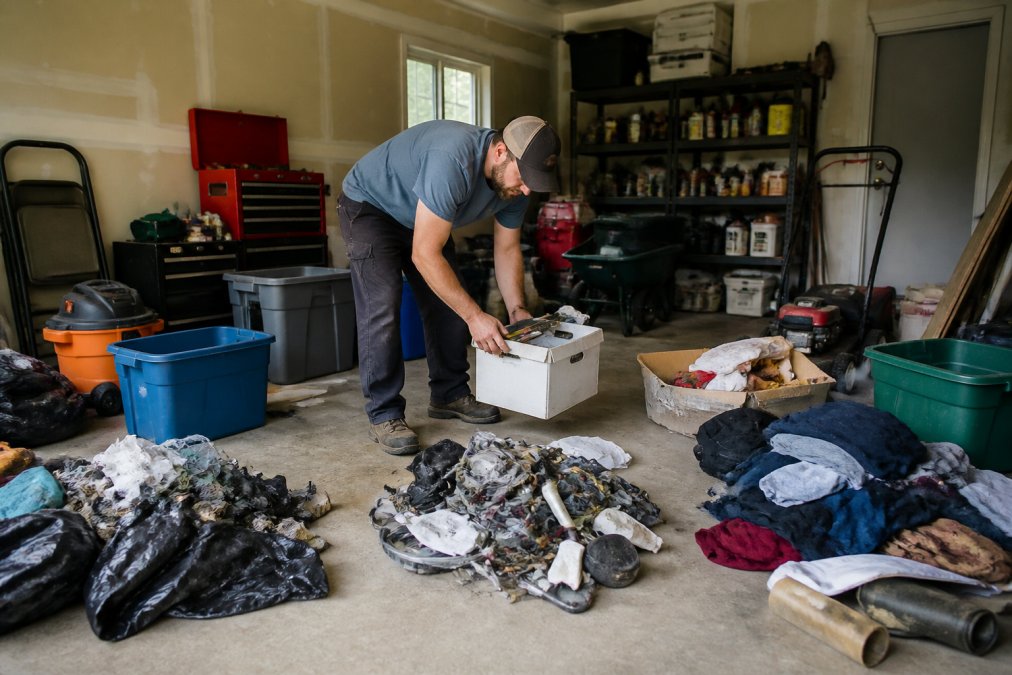
- Clear the floor first. Move everything to the driveway or center of the garage so you can see the space.
- Mark three zones with tape or cardboard signs: keep, toss, donate.
- Sort by category, not by item. Do all hand tools, then garden supplies, then seasonal decor. Batching beats jumping around.
- Apply the two-year rule. If you have not used it in two years and it is not seasonal, it goes.
- Bag the toss pile immediately. Loose junk migrates back into the keep pile if you leave it sitting.
A common mistake is starting with sentiment. Do the easy, obvious junk first. Momentum matters more than perfect decisions on day one.
Hazardous Waste in the Garage: Paint Cans, Chemicals, and E-Waste
Hazardous waste cannot go in your regular trash. Paint cans, solvents, pesticides, motor oil, antifreeze, and old electronics require special handling, and many curbside programs refuse them outright. This is the part most garage decluttering guides skip, and it can cost you a fine.
What Counts as Household Hazardous Waste
The Environmental Protection Agency classifies household hazardous waste as products containing corrosive, toxic, flammable, or reactive ingredients (the EPA). In a garage, that usually means:
- Paints and finishes: oil-based paint, stain, varnish, polyurethane, paint thinner, mineral spirits, and aerosol spray paint
- Automotive fluids: motor oil, antifreeze, brake fluid, transmission fluid, gasoline, and diesel
- Yard and pest chemicals: weed killer, insecticide, rodenticide, fertilizer with pesticides, and pool chlorine
- Batteries and lighting: car batteries, lithium-ion packs, rechargeable batteries, and fluorescent tubes (which contain mercury)
- E-waste: TVs, computer monitors, printers, laptops, and anything with a cord or circuit board
Latex (water-based) paint is the exception. Once fully dried and hardened, many municipal waste programs accept it as regular trash, but confirm with your local solid waste authority first (the EPA). To dry it, add cat litter or a commercial paint hardener, leave the lid off in a ventilated area, and wait until the contents are solid.
How to Dispose of It Legally
There is no single national drop-off system; disposal runs through state and county programs, and rules change by location. The reliable path:
- Find your local household hazardous waste facility. Search your county or state environmental agency website for ‘household hazardous waste’ plus your county name. Most states run permanent drop-off sites plus one-day collection events.
- Check the accepted-materials list before you load. Some facilities take paint but not tires, or batteries but not propane tanks. Unaccepted items usually mean hauling them home.
- Keep items in original containers when possible. If the label is gone, label the container yourself. Unlabeled mystery jugs are frequently rejected.
- Never mix chemicals. Combining unknowns can create toxic fumes or a fire hazard and makes the load unrecyclable.
- Transport upright and secured. Put containers in a lined box or tote so a tipped can does not leak through your vehicle.
For e-waste, many states ban TVs, monitors, and computers from landfills (the EPA). Best Buy and Staples run in-store drop-off programs for select electronics, and manufacturer take-back programs exist for many brands. Check the brand’s website before assuming it must go to the county facility.
Never pour paint, solvents, pesticides, or automotive fluids down a drain, onto the ground, or into a storm sewer. Storm drains typically flow untreated to local waterways, and improper disposal of hazardous waste can carry civil penalties under state environmental laws. If a container has leaked in your garage, ventilate the area, wear gloves, and absorb the spill with cat litter or sand before disposing of the soaked material as hazardous waste.
What to Do With the Leftovers You Want to Keep
If you are keeping paint for touch-ups, it does not belong on a shelf where it can freeze, crack, or get knocked over. Store it in a sealed cabinet, label the lid with the room and date, and keep only what you will use within two years. Anything older is a disposal item, not a storage item.
If you are unsure whether something qualifies as hazardous, treat it as hazardous. A quick call to your waste authority beats a fine or a contaminated load. And if the volume of chemicals, paint, and e-waste is more than you want to sort, a junk removal company can take the whole category off your hands.
Vertical Storage and Organization: Reclaiming Your Garage Floor
Floor space is the most valuable real estate in your garage, and most of it is wasted. The fix is vertical storage: move everything you can off the floor and onto walls and ceilings. Whether a system holds or collapses comes down to three numbers: how much it weighs, what it is fastened to, and how high it sits.
Start With a Weight Budget
Before you buy a single bracket, estimate what each category weighs. A rough working guide:
- A standard 27-gallon storage tote packed with holiday decor: 30 to 50 pounds
- A full set of hand tools on a pegboard: 20 to 40 pounds
- Bicycles: 25 to 35 pounds each
- A ladder: 20 to 40 pounds
- Seasonal tires: 40 to 60 pounds each
- A loaded shelving bay of paint and chemicals: 200 pounds or more
Add up the categories you plan to store, then add a 50 percent safety margin. That total is what your wall and ceiling hardware has to carry, not the weight of the empty bins.
Wall Systems: Pegboards, Slatwall, and Rail Racks
Pegboard is the cheapest entry point and best for hand tools, cords, and small hardware because everything stays visible. Standard 1/8-inch and 3/16-inch holes accept most hooks, but the board itself is weak. Mount 1/4-inch pegboard over furring strips or a plywood backer so hooks have something solid to bite into, and fasten the backer into wall studs with 2-1/2-inch or longer screws. Pegboard alone will pull off drywall under a loaded tool hook.
Slatwall costs more but carries far more weight per square foot and accepts shelves, baskets, and hooks on one panel. It is the better choice for power tools, bike gear, or anything over 30 pounds.
Rail-mounted hook systems (the track-and-hook style sold at home centers) install fastest and rearrange easiest. Anchor the rail into studs, not drywall anchors, and check the manufacturer’s per-hook rating before hanging a ladder or wheelbarrow.
Overhead Racks: The Rules That Keep Them Up
Ceiling storage is where most DIY installs fail. A few non-negotiables:
- Mount into joists, never drywall. Use a stud finder to locate ceiling joists, then confirm with a small pilot hole. Joists typically run 16 or 24 inches on center.
- Match the fastener to the load. Lag bolts or structural screws rated for the rack’s capacity, long enough to pass through the bracket and at least 1-1/2 inches into the joist. Drywall anchors and toggle bolts are not acceptable overhead.
- Respect the rack’s rating. Most consumer overhead racks are rated 250 to 600 pounds when properly installed, assuming even weight distribution and correct fastening.
- Leave clearance. Measure your vehicle height plus at least 12 inches of headroom before deciding how low the rack can hang. A rack that clears the roof but not the open liftgate is a problem.
- Do not hang a rack from a finished ceiling without verifying what is above it. A garage with living space overhead may have plumbing, ductwork, or a shallower joist than expected.
If you are not comfortable locating joists, reading load ratings, or working overhead, hire a handyman or garage storage installer. A collapsed overhead rack damages cars and people, and the labor cost is small next to the repair bill.
Shelving and Cabinets: Freestanding vs. Wall-Mounted
Freestanding steel shelving handles bulky items like bins, coolers, and holiday decor, and it is the most forgiving option because you can reposition it. Anchor every unit to the wall with an anti-tip strap, even the short ones; a loaded unit tips forward when a top shelf is overloaded or a door is pulled open.
Wall-mounted cabinets free up floor space and keep chemicals and small parts out of sight, but they require the same stud-anchoring discipline as overhead racks. For a garage with temperature swings, choose steel or heavy-duty resin over particleboard, which swells and sags with moisture.
Labeling and Bin Systems That Stay Organized
Clear bins beat opaque ones because you can see contents without opening them. Label every bin by category, not by room: ‘Camping,’ ‘Car Care,’ ‘Holiday Decor.’ A label maker or painter’s tape and a marker works.
Match the bin to the shelf. A 27-gallon tote is too heavy to lift from an overhead rack, so keep those on the floor or low shelves and use smaller bins up high. Keep the most-used categories at waist height and once-a-year items overhead.
The system that stays organized is the one with the fewest steps between you and putting something away. If a bin is hard to reach, unlabeled, or too heavy to lift, the clutter returns within a season. Build the storage around your habits, not the other way around.
A Simple Sequence for Installing Vertical Storage
- Empty the wall or ceiling area you plan to use and sort what will go back.
- Estimate the weight of each category and add a 50 percent margin.
- Locate studs and joists and mark them with painter’s tape.
- Install the heaviest, least-used storage first (overhead racks), then wall systems, then floor shelving.
- Load from the bottom up and check fasteners after the first week and after the first seasonal change.
When to Call Garage Junk Removal Services
Professional garage junk removal services make sense when the volume is too large for your vehicle, items are too heavy to lift safely, or hazardous materials are involved. A single trip to the transfer station with a loaded trailer is rarely worth the time, fuel, and disposal fees.
Hoosier Junk Daddy handles the full job: sorting, loading, hauling, and cleanup afterward. We recycle, donate, or properly dispose of what we haul, and we can often schedule same-day service when timing matters, such as a real estate closing or tenant turnover.
What Garage Cleanout Service Cost Depends On
Garage cleanout service cost depends on volume, weight, access, and materials, not a flat rate. A single-car garage with light household clutter prices differently than a three-car garage packed with construction debris or appliances.
Because pricing varies this much, Hoosier Junk Daddy offers free on-site estimates so you know the number before we start. No surprise fees, no guesswork. Request a quote on our website for current pricing in your area.
| Factor | Why It Changes the Price | What to Do |
|---|---|---|
| Volume | More truck space = higher cost | Sort first to shrink the load |
| Weight | Heavy debris costs more to dispose | Separate metal and appliances |
| Access | Stairs or tight driveways slow the job | Clear a path before arrival |
| Hazmat | Special handling and fees apply | Identify chemicals in advance |
Seasonal Maintenance: Keeping Your Garage Clutter-Free Year-Round
Clutter returns because nothing prevents it. A short seasonal routine keeps the garage from sliding back into storage-unit territory.
- Spring: Purge winter gear, sweep the floor, check for moisture or pests.
- Summer: Rotate lawn and garden tools to the front, store off-season items overhead.
- Fall: Move summer equipment back, bring snow gear forward, restock salt and shovels.
- Winter: Do a quick sweep for broken items and expired chemicals, and schedule a haul-away if the pile has grown.
Fifteen minutes per season beats a full-day cleanout every few years.
Garage clutter builds because the space has no system, and clearing it out gets easier the moment you stop doing it alone. If the pile is bigger than a few trash bags, or if paint cans, chemicals, and old appliances are in the mix, Hoosier Junk Daddy can handle the whole cleanout. We offer free on-site estimates, transparent pricing, responsible recycling and donation, and full-service removal that includes cleanup afterward. Get started with Hoosier Junk Daddy and reclaim your garage floor this week.
Frequently Asked Questions
What is the best way to clear out garage clutter?
Start by sorting items into keep, toss, and donate piles. Use a garage decluttering checklist to stay on track, then tackle hazardous waste like paint cans and old electronics separately. Once the floor is clear, add vertical storage such as shelving units and pegboards. If the job feels overwhelming or you have a deadline, garage junk removal services can haul everything away in one visit.
What is the 5-5-5 rule for decluttering?
The 5-5-5 rule asks you to find five items to toss, five to donate, and five to relocate to another room in the house. It works well for garage clutter because it forces quick decisions without requiring you to sort the entire space at once. Repeat the cycle as many times as needed. Many people find it easier to start with small batches than to face a full garage cleanout in one day.
How much does a garage cleanout service cost?
Garage cleanout service cost depends on how much you have, what type of debris it is, and how accessible the garage is. Hazardous materials, heavy items, and tight spaces can add time and handling requirements. Hoosier Junk Daddy offers free on-site estimates and transparent pricing, so you know the cost before any work begins. Check the website or request a quote for current rates.
Can junk removal services handle hazardous garage waste?
Reputable garage junk removal services can handle many items, but hazardous materials like paint cans, motor oil, and old electronics often require special disposal. Ask ahead about chemical disposal, recycling, and donation policies. Hoosier Junk Daddy diverts up to 60 percent of hauled items from landfills through recycling, reuse, or donation.