Table of Contents
- Step 1: Decide Between Recycling, Donation, or Disposal
- Step 2: Check State and Local Mattress Disposal Rules
- Step 3: Find a Mattress Recycling Center or Drop-Off Location
- Step 4: Explore Retailer Take-Back and Donation Programs
- Step 5: Schedule Curbside Collection or Bulky Item Pickup
- Step 6: Learn How to Prepare a Mattress for Pickup
- Step 7: Understand Junk Removal Services Cost and When to Hire Help
- Frequently Asked Questions
Last Updated: September 10, 2026
Step 1: Decide Between Recycling, Donation, or Disposal
Figuring out how to dispose of old mattress starts with one question: is it still usable? A mattress that can be donated follows a completely different path than one headed for the landfill.
The average mattress contains roughly 25 to 50 pounds of recoverable steel, foam, and fiber (mattressrecyclingcouncil.org). When you dispose of an old mattress the right way, most of that material gets a second life instead of sitting in a landfill for decades.
Is Your Mattress in Good Enough Condition to Donate?
Donation centers typically accept mattresses that are stain-free, odor-free, and free of rips or sagging. If yours still has its original fire tag and no visible damage, it is a strong donation candidate.
Furniture banks and charity thrift stores often refuse anything with body fluids, pest activity, or heavy wear, so call ahead before you haul it across town.
When Recycling Makes More Sense Than Donation
Recycling is the better route when your mattress is stained, sagging, or simply too old to sleep on but still intact enough to break down. Mattress Recycling Council program overview explains how steel springs, polyurethane foam, and textile layers get separated and reused.
If pests or moisture damage are involved, recycling usually beats donation because most charities will turn it away.
Check for the law tag on the bottom of your mattress before anything else. Donation centers and recyclers often use it to confirm the mattress isn’t recalled or under a manufacturer safety notice.
Step 2: Check State and Local Mattress Disposal Rules
Disposal rules vary widely, and ignoring them is how people end up with an illegal dumping citation. Some states run mattress recycling programs funded by a fee added at purchase; others leave disposal to local municipal waste management.
How State Mattress Stewardship Laws Actually Work
A handful of states have passed mattress stewardship laws that shift the cost of end-of-life disposal onto the manufacturer and buyer rather than the taxpayer. A small per-unit fee is collected at the point of sale on every new mattress and box spring sold in that state, funding a statewide network of collection sites, transporters, and recyclers.
States with this type of program include California, Connecticut, Rhode Island, Oregon, and Massachusetts. If you live in one, you generally have a right to drop off your old mattress at a participating collection site, often a transfer station, retailer, or designated nonprofit, for free or a nominal handling charge, since the recycling cost was paid at purchase.
Mattress Recycling Council program overview explains how steel springs, polyurethane foam, and textile layers get separated and reused.
What to Ask Your City or County
Cities and counties set their own curbside and bulky item pickup rules. A mattress left on the curb without a scheduled pickup is often treated as illegal dumping, even on your own property line. Some municipalities allow one free bulky item pickup per household per year; others charge a flat per-item fee or require a sticker from the sanitation department.
Before you plan anything, call your city’s public works department or check its waste services page. Ask these questions:
- Does the city pick up mattresses curbside, or only through a scheduled bulky item appointment?
- Is there a per-item disposal fee, and how is it paid, online, by sticker, or in cash at the facility?
- Does the pickup cover box springs and foundations, or mattresses only?
- Where is the nearest drop-off location, and what are its hours?
- Does the hauler require the mattress to be wrapped in plastic before collection?
The Illegal Dumping Trap
Most states treat a mattress abandoned on a roadside, in an alley, or beside a dumpster as illegal dumping, with fines running into the hundreds or thousands of dollars depending on jurisdiction and whether it’s a repeat offense. Even leaving one at the curb on a non-pickup day can trigger a citation. The safe pattern: confirm the rule first, schedule the pickup or drop-off second, and only then move the mattress.
Check for the law tag on the bottom of your mattress before anything else. Donation centers and recyclers often use it to confirm the mattress isn’t recalled or under a manufacturer safety notice.
Step 3: Find a Mattress Recycling Center or Drop-Off Location
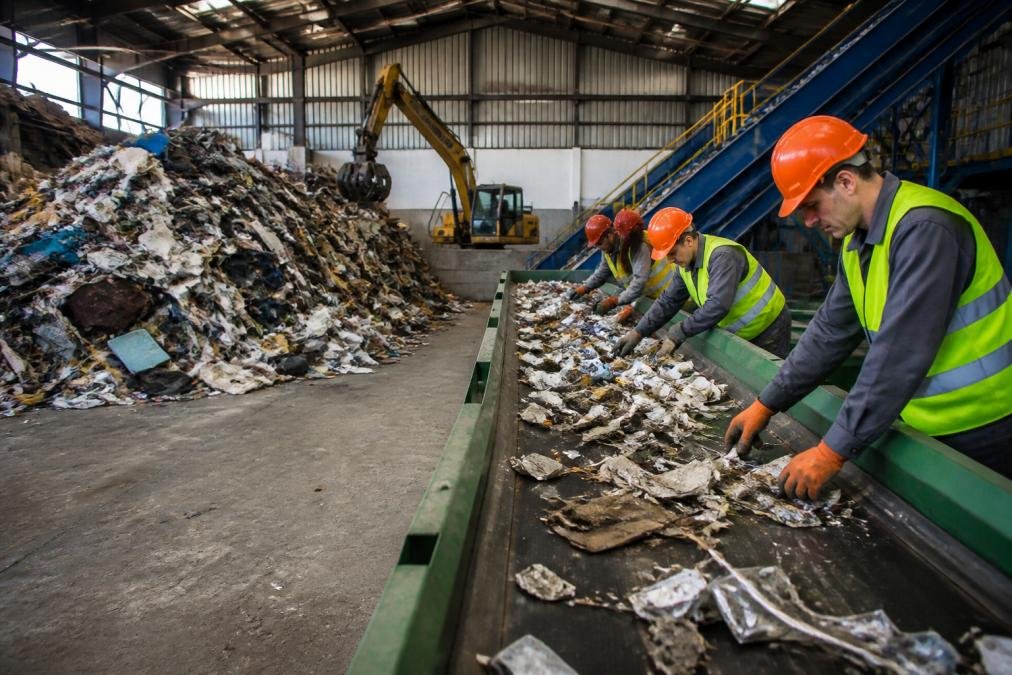
A mattress recycling center accepts used mattresses and dismantles them into recyclable materials rather than sending them to a landfill. Most metro areas have at least one, though it may be a county transfer station rather than a dedicated plant.
What Actually Happens Inside a Mattress Recycler
A typical mattress recycling line works in roughly this order:
- Intake and inspection. Staff check for pests, heavy contamination, or wet mattresses and reject anything that poses a sanitation risk to workers.
- Deconstruction. Workers cut the ticking (the fabric cover) away from the core, then separate the comfort layers from the support core.
- Material separation. The major streams are steel (innersprings and box spring coils), polyurethane foam, and fiber/textile (cotton, polyester, and the ticking itself). Some facilities also recover wood from box spring frames.
- Baling and shipping. Steel is baled and sold to scrap metal processors. Foam is often shredded and sold into carpet padding, underlayment, or rebonded foam products. Fiber and textiles may become industrial wiping cloths, insulation, or padding.
A common industry figure is that roughly 80 to 90 percent of a mattress by weight can be diverted from landfill this way, with steel typically the most valuable recovered material. The exact rate depends on the facility and how contaminated the mattress is.
DIY Mattress Breakdown for Home Recycling and Upcycling
If you want to keep your mattress out of the waste stream without paying a recycler, you can dismantle it yourself. Memory foam and hybrid beds are messier and harder to separate than a traditional innerspring, but it’s a legitimate option for eco-conscious households willing to put in a few hours of work.
Tools you’ll need:
- A sharp utility knife with spare blades
- Heavy-duty work gloves
- Safety glasses and a dust mask (foam and fiber release fine particles)
- Bolt cutters or heavy tin snips for the coil unit
- A tarp or drop cloth to contain debris
- Contractor bags for foam and fiber
The basic sequence:
- Lay the mattress flat on a tarp in a well-ventilated area, a garage, driveway, or covered patio. Avoid doing this indoors.
- Cut the ticking along the seam and peel it back. Underneath you’ll usually find a fiber pad, then the foam comfort layer, then the coil unit.
- Roll or fold the fiber and foam layers and bag them separately. Many municipal recycling drop-offs accept clean foam with other bulky plastics; check locally first.
- Expose the innerspring or coil unit. Most scrap metal yards and municipal metal drop-offs accept mattress coils as scrap steel, often free or for a small per-pound payout.
- Bag the ticking and any non-recyclable trim for regular trash.
What you can realistically do with each material:
- Steel coils and box spring frames, scrap metal recyclers; this is the highest-value stream and the easiest to place.
- Polyurethane foam, some carpet-padding manufacturers and craft suppliers accept clean foam; otherwise it typically goes to landfill because most curbside programs don’t take it.
- Cotton and fiber batting, limited local options; occasionally accepted by textile recyclers or used as shop rags.
- Ticking and trim, usually trash unless a textile recycler is nearby.
Never cut into a mattress that has visible mold, pest activity, or a chemical odor. Bag it whole and route it to a landfill or a hauler that handles contaminated items. Cutting into a contaminated mattress releases spores and allergens into your workspace.
Finding a Facility Near You
Search your county’s solid waste website for “mattress recycling near me,” or call the facility to confirm hours, fees, and whether they accept box springs and foundations too. In a stewardship state, start with the program’s official site, it usually lists every free drop-off point.
| Option | Best For | Typical Effort | Cost Consideration |
|---|---|---|---|
| Recycling center drop-off | Intact mattresses, eco-conscious disposal | You transport it | Facility may charge a per-item fee |
| Curbside bulky item pickup | Single-family homes with scheduled service | You set it at the curb | Often free or a small fee |
| Retailer take-back program | Mattresses bought recently | Depends on retailer policy | Varies by retailer |
| Junk removal service | Damaged mattresses, apartments, tight timelines | None, full-service | Priced by volume and labor |
| DIY breakdown | Eco-conscious households with time and tools | Several hours of labor | Free, minus tool cost |
Step 4: Explore Retailer Take-Back and Donation Programs
Many mattress retailers offer a take-back program when you buy a replacement, hauling away the old one for a fee or sometimes free, often the simplest path, since the delivery crew removes the old mattress the same day the new one arrives. Ask before you buy: some stores only take back the mattress they sold you, while others accept any brand. Get the pickup terms in writing so there is no surprise on delivery day.
Step 5: Schedule Curbside Collection or Bulky Item Pickup
Bulky item pickup is a scheduled service where your municipal waste hauler collects large items like mattresses that don’t fit in a standard bin. Most cities require you to call or book online at least a few days ahead, and some limit how many bulky items you can set out per year. You’ll usually need to place the mattress at the curb by a specific time, often the night before; miss the window and you may need to reschedule.
Step 6: Learn How to Prepare a Mattress for Pickup
How to prepare a mattress for pickup comes down to three things: wrap it, label it, and place it correctly. Most haulers require mattresses to be bagged or wrapped in plastic so they don’t absorb moisture or pose a sanitation risk.
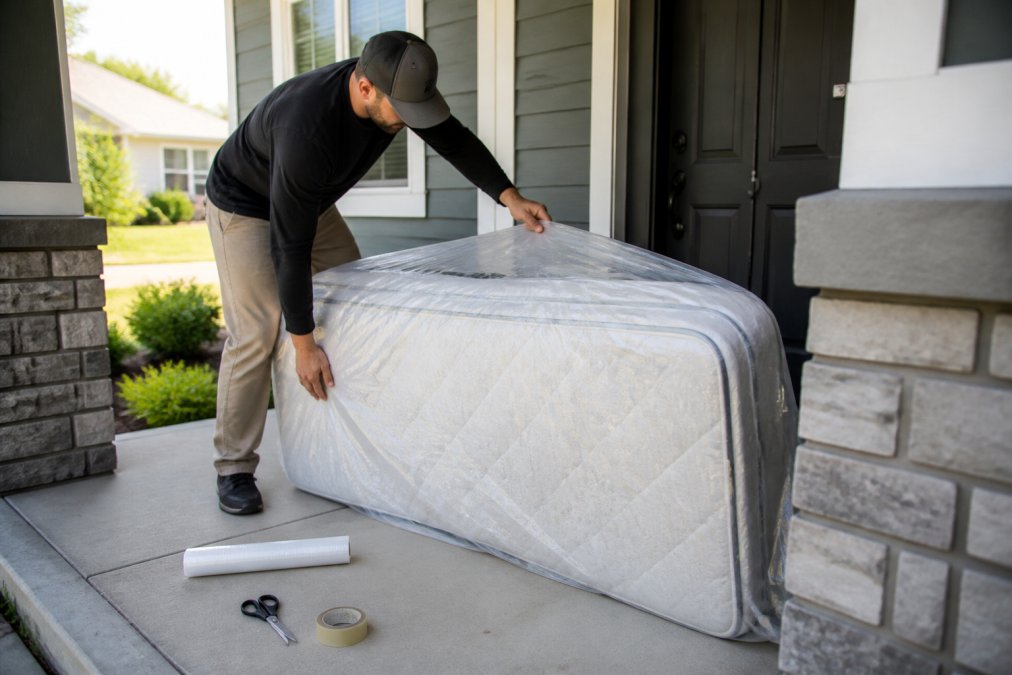
Here is the preparation checklist most haulers expect:
- Remove all bedding, pillows, and mattress protectors
- Vacuum the surface to remove dust and debris
- Wrap the mattress and box spring separately in plastic sheeting or a mattress bag
- Seal all seams with packing tape
- Label it clearly if your city requires a bulky item sticker
- Place it at the curb no earlier than the evening before pickup
Skipping the plastic wrap is the most common reason a hauler refuses a mattress at the curb. Unwrapped mattresses can be rejected on sight, leaving you to reschedule and start over.
Step 7: Understand Junk Removal Services Cost and When to Hire Help
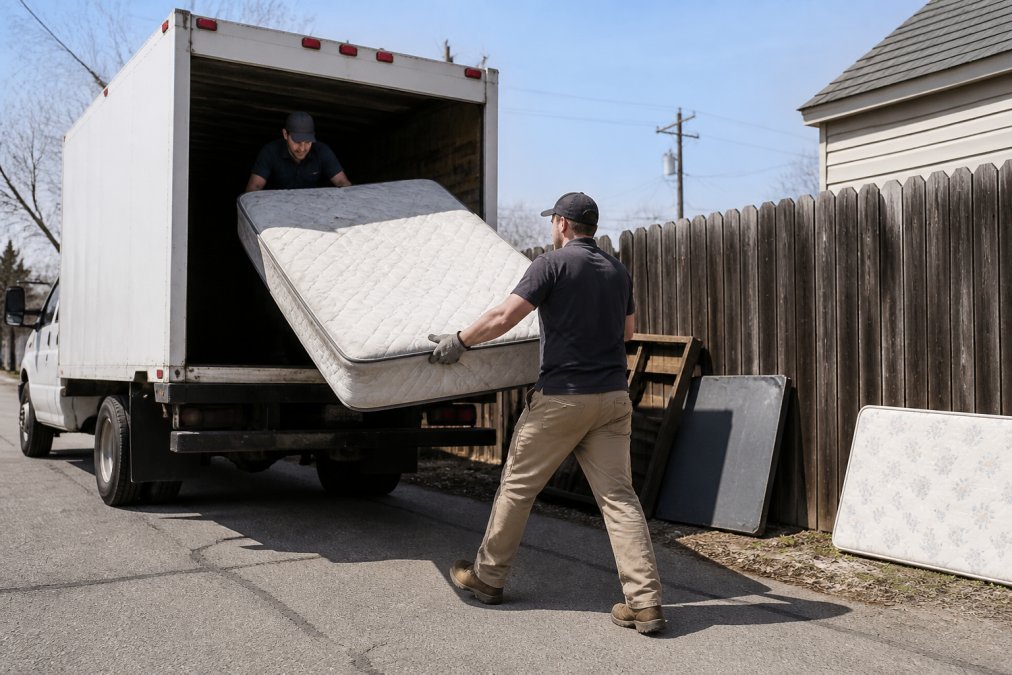
Junk removal services cost depends on volume, weight, access, and labor. A single mattress is usually the cheapest tier; a full bedroom set or multi-unit cleanout pushes the price higher.
What Affects the Price of Mattress Removal?
Pricing reflects how much space your items take up in the truck, how heavy they are, and how far the crew has to carry them. Stairs, elevators, and tight hallways all add labor time, which shows up in the quote. Most reputable providers offer a free on-site estimate; Hoosier Junk Daddy provides transparent pricing with free on-site estimates, so there is no guessing.
Apartment and High-Rise Logistics: What to Know Before You Book
Apartment and high-rise pickups add a layer most guides skip: building rules. Many properties require a certificate of insurance from the hauler, a reserved elevator time, and advance notice to the front desk. Book around your building’s move-out windows, and confirm whether the crew can use the freight elevator. This is where a full-service provider saves real headaches, since the crew handles the carry-out, loading, and cleanup.
For apartment and high-rise jobs, the deciding factor is rarely the mattress itself. It’s the building’s access rules, and a provider who already knows how to navigate them.
Knowing how to dispose of old mattress gets complicated fast when you’re juggling state rules, pickup windows, and building access. Hoosier Junk Daddy handles the entire process for you, from wrapping and hauling to responsible recycling, donation, or landfill transport, with eco-friendly practices that divert up to 60% of hauled items from landfills. With transparent pricing, free on-site estimates, and same-day service when possible, you can reclaim your space without lifting a finger. Get started with Hoosier Junk Daddy and book your mattress removal today.
Frequently Asked Questions
What is the easiest way to get rid of an old mattress?
The easiest option is scheduling a bulky item pickup or hiring a junk removal service. Many municipal waste management departments offer curbside collection for a small fee, but you may wait a week or more for pickup. A professional junk removal company can often haul it away the same day, handle all the lifting, and ensure the mattress is recycled or donated instead of sent to a landfill.
Can I donate a used mattress to charity?
Yes, but most charities only accept mattresses that are clean, stain-free, and free of tears or bed bug infestation. Mattress donation centers like furniture banks and local shelters often have specific sanitation standards. Call ahead to confirm they accept mattresses and ask about their donation eligibility requirements. If your mattress has any stains, rips, or signs of pests, recycling is a better option.
How do I prepare a mattress for professional removal?
Strip all bedding, sheets, and mattress protectors. Inspect the mattress for bed bugs or stains. Wrap it in plastic sheeting or a mattress bag and seal it with tape to prevent tearing and contamination during transport. Remove any bed frame or box spring separately if possible. Clear a path from your bedroom to the exit so the removal team can move quickly and safely.
Is it better to recycle or trash an old mattress?
Recycling is almost always the better choice. Mattresses contain recyclable materials like spring steel, polyurethane foam, and textile fibers that can be repurposed into new products. Landfill diversion reduces environmental impact and supports the circular economy. Many states have mattress recycling programs or take-back options through retailers. If recycling is not available in your area, check for donation options before choosing the landfill.